Hiring Best Practices
How to Standardize Interviews for Distributed Hiring Teams
 InterWiz Team•November 28, 2025•6 min read
Unstructured interviews have a predictive validity of 0.21. This means they are not very effective at predicting how a candidate will perform on the job. Therefore, the key to achieving predictability in the hiring process is to conduct structured interviews.
Along with improved consistency, standardized interviews help avoid common issues such as language barriers, time zone differences, and internet outages.
Let’s take a look at how standardized interviews increase accuracy and efficiency in distributed hiring.
What is Interview Standardization?
Interview standardization is the process of creating a consistent interview format for each candidate. This includes the same pre-determined questions, evaluation criteria, and even the tone and culture of an interview.
This helps remove any bottlenecks, increases evaluation accuracy, and results in more successful hires. Standardized interviews offer the following benefits in distributed hiring:
Increased fairness and equity: Asking the same questions and creating the same scenarios for each candidate promotes fairness and reduces discriminatory practices.
Reduced bias: Standardizing interviews minimizes hidden bias. Following the same format ensures candidates aren’t affected by favoritism or the interviewer's moods.
Improved predictive accuracy: Using the same interview pattern for all candidates offers clearer insight into potential job performance than unstructured interviews.
Increased efficiency: With uniform interviews and clear evaluation criteria, hiring across distributed teams becomes easier and more organized.
Legal defensibility: A structured, documented interview process strengthens legal protection if an interview is ever challenged.
Step-by-Step Guide to Standardize Interviews for Distributed Hiring
Standardized interviews require careful planning and coordination across departments. With the right preparation, you can ensure a fair, consistent, and effective hiring process. Here’s a step-by-step guide to help you get started.
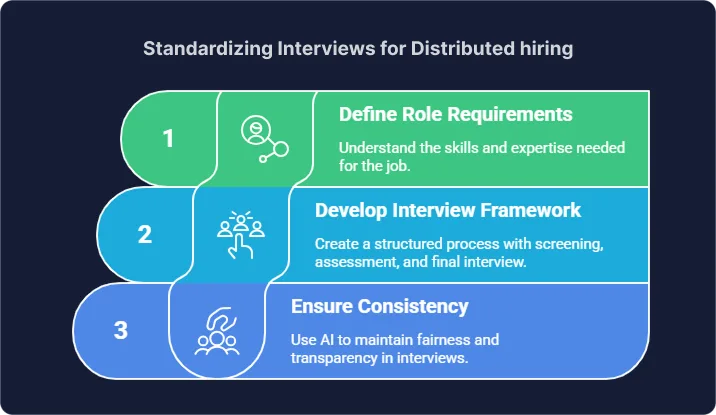
Step 1: Define Role Requirements and Competencies
Begin by understanding the skills and level of expertise required for a job role. For example, if you’re hiring a Remote Node Developer, talk to the tech department to clarify the knowledge mix you’re looking for. This might include a certain number of years of experience, proficiency with specific Node.js libraries, and familiarity with your company culture. Decide on the evaluation criteria before proceeding so that no factors mislead you. Study the behavior of employees in similar roles within your company to better understand the behavioral traits you’re seeking.
Step 2: Develop a Structured Interview Framework
For most job roles, a typical interview flow includes an initial screening, a live or take-home assessment, and a final interview. Here’s the difference between all these stages:
Screening: Use standardized interview questions to filter candidates based on core competencies. This includes assessing background, work ethic, experience, etc.
Assessment: Test candidates’ real-world abilities with a small project. For example, asking a Junior Node.js developer to create a basic Node backend.
Final interview: Conduct a longer conversation between the applicant and 2–3 team members, covering day-to-day responsibilities, scenario-based challenges, and any expectations the candidate should know in advance.
After resume shortlisting, most candidates are filtered out during the initial screening. Considering this, you need a core set of standardized interview questions aligned with key competencies and job requirements to ensure you’re shortlisting the best candidates. Here’s what it means:
Define standardized interview questions: Align your questions with the core skills, behavioral traits, and job requirements needed for the role. This ensures every candidate is evaluated on consistent criteria.
Outline your end-to-end interview process: Decide on the format and flow of your interview stages, such as whether to include a technical test, behavioral round, or follow-up discussion.
Step 3: Ensure Consistency Across Candidates
Humans are naturally biased and influenced by many internal and external factors beyond their control. This can create unfavorable interview situations for some candidates, introduce bias, and reduce the chances of a successful hire.
Therefore, it’s essential to keep interview questions consistent and stick to them regardless of the conversation flow; otherwise, you invite bias into the process.
That’s where an AI interviewer is your lifesaver. It maintains a consistent tone regardless of who the interviewee is. And if you’re using Interwiz AI for screening candidates, you get end-to-end hiring assistance with full transparency and control. Here’s how it works:
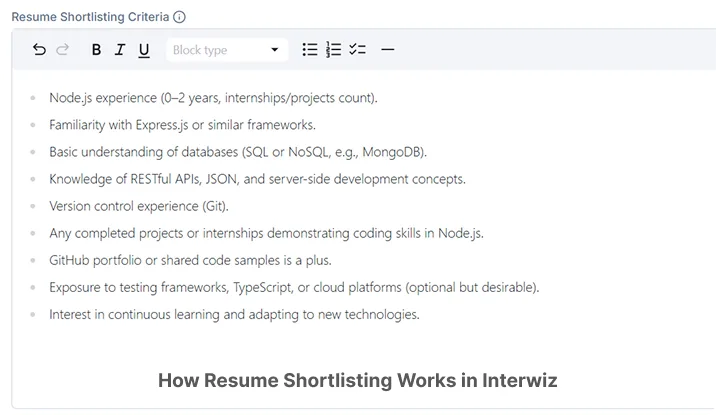
Pinpoint integration helps you shortlist resumes based on your preferred criteria.
Once you’ve shortlisted resumes, you can let Interwiz AI tool select screening interview questions for your job opening or set your own.
The AI interviewer conducts interviews with fairness, consistency, and transparency.
You receive a detailed report on candidate performance, communication skills, reliability, and more.
Step 4: Implement Standardized Evaluation Tools
Using structured rating scales (such as 1 to 5) for each interview question eliminates guesswork and ensures all candidates are evaluated against the same criteria. When paired with clear rubrics defining what “poor,” “average,” and “excellent” answers look like, interviewers can score responses more consistently and fairly.
AI interviewers further improve objectivity by generating standardized scorecards, recording interviews, and ensuring every candidate is evaluated against all criteria. Automated screening and scoring not only make hiring more manageable but also faster and more cost-effective than relying solely on human recruiters.
However, evaluation criteria may vary by role, and the Interwiz AI tool keeps that in mind. For example, a project manager requires strong communication and negotiation skills, whereas a backend engineer is evaluated more on problem-solving depth, system design reasoning, and coding proficiency.
Step 5: Review and Continuously Improve Process
Before deploying your standardized interview format to applicants, test it with your colleagues first. Collect feedback from both interviewers and candidates to identify any delays, confusion, or bias in the process.
Choose an AI interviewer with a free trial to streamline structured assessments. Regularly update your interview questions, scoring rubrics, and training materials to ensure your hiring process becomes smarter and more effective over time.
How Standardized Interviews Cut Distributed Hiring Costs
In addition to making the entire interview process more organized, standardized interviews also help cut distributed hiring costs. These costs include both time and money because:
Standardized interviews improve efficiency and consistency, leading to better hiring decisions.
Consistent process reduce expenses related to turnover and legal issues.
Pre-determined evaluation rubrics enable faster assessments, which speeds up decision-making.
The average cost of hiring an employee can be three to four times the position’s salary. This includes advertising, recruiter fees, recruitment technology, assessment costs, and more. Even hiring a part-time contractor for $1,500 per month could cost $4,500 to $6,000 to find the right candidate.
With Interwiz, you can cut most of these costs while improving the quality of your hires. Interwiz supports you throughout the recruitment process from shortlisting candidates to selecting top talent.
A screening interview costs just $4, and an in-depth interview is only $10. Interview questions on the Interwiz AI assistant are crafted with input from experienced hiring professionals. Along with reducing recruiter fees, you also save on applicant tracking systems and other tools such as schedulers or coding test platforms. Interwiz handles everything on a single platform at minimal cost.
Book a demo today to see how it works or start a free trial to get started immediately.
Speed Up Distributed Hiring While Maintaining High Quality
Distributed hiring has become a necessity due to rising hiring costs, talent shortages, and increasing flexibility requirements. However, assessing candidates from across the globe can be challenging. Standardizing interviews helps address most of these challenges.
Interwiz AI makes distributed hiring easier, faster, and more cost-effective by combining AI assistance with human expertise. You have full control over designing your interviews, and our AI assistant is trained by real, expert humans.
Start your free trial today to see how Interwiz can be the only HR assistant you’ll ever need.
Distributed Hiring FAQs
What is a distributed workforce?
Distributed workforce refers to a team of employees who work from different physical locations rather than being centralized in a single office. This can include remote employees working from home, team members in different cities or countries, or a mix of in-office and remote staff.
Which is the best method of recruitment?
The best recruitment method depends on your business needs. For enterprises and startups, standardized interviews are the most effective choice, as they reduce friction and improve efficiency. Using AI for standardized interviews is the cherry on top: candidates enjoy a seamless, high-quality interview experience, while you benefit from a complete package of quality, efficiency, and cost reduction.
What is the difference between remote work and distributed work?
Remote work allows employees to work outside a central office. Distributed work involves a team spread across multiple locations, sometimes across cities or countries, with no central office.

High Quality Screening with AI Interviews
Automated interviews built for speed, scale, and accuracy.
🔥 Full features, no credit card required.