Hiring Best Practices
How to Adopt Skill-Based Hiring: A Step-by-Step Guide
 InterWiz Team•December 12, 2025•7 min read
Talent pools expand nearly 10x when companies adopt a skills-first approach. Beyond wider access to talent, this method leads to longer employee tenure, better predictability in hiring outcomes, and significant cost savings. It’s no surprise that 81% of employers are now investing in skills-based hiring.
Let’s break down how to implement a skills-based hiring approach in your organization, the best practices to follow, and the common mistakes to avoid.
What Is Skills-Based Hiring?
As the name suggests, skills-based hiring focuses on a candidate's abilities rather than their academic background. It relies on structured interviews and assessments to evaluate whether a candidate can perform the job effectively and thrive within your company. This approach emphasizes a candidate’s coachability, which improves performance predictability, unlike traditional hiring that relies on degrees and certificates instead of practical capabilities.
However, some organizations design lengthy or overly complex assessments that can cause candidates to lose interest. To avoid this, careful planning is essential. A successful skills-based hiring process requires well-defined job descriptions, thoughtfully designed assessments, and unbiased interviewing practices.
How To Implement Skills-Based Hiring?
28% of organizations face difficulties managing skills-based practices. You can avoid this with a clear plan and checklist. Here’s how to implement skills-based hiring, from defining job descriptions to refining the entire process.
Redefine your job descriptions and job postings
Focus on skills: Clearly highlight the core skills and competencies needed for the role, making a degree a requirement only when absolutely necessary.
Widen the talent pool: Use inclusive, accessible language to attract a more diverse range of qualified candidates.
Prioritize the work to be done: For example, instead of labeling an opening as a 'JavaScript wizard,' clearly list the skills needed, such as proficiency in specific frameworks, debugging, and writing clean, efficient code.
Develop objective skill assessments
Use multiple methods: Incorporate screening interviews and practical assessments to evaluate a candidate’s real abilities. This approach allows you to test both the candidate’s soft skills and practical knowledge.
Assess existing capabilities: Design assessments that reflect real job tasks instead of textbook questions. For example, if you’re hiring a front-end developer, ask candidates to create a React component rather than solving a series of data structure problems.
Use a clear rubric: Shortlist candidates based on consistent scoring criteria. For example, assign 4 points to candidates who speak fluent English and 3 points to candidates with experience in specific technologies.
Adapt the interview process
Ask skills-based questions: Build interviews around competencies and how candidates approach job-related tasks, rather than focusing only on past experiences.
Consider more than technical skills: Include behavioral questions to get a clearer picture of how a candidate would perform in real workplace scenarios.
Focus on personality and cultural fit: Observe traits such as energy, work ethic, and interpersonal style to ensure candidates align with your company culture, which supports long-term success.
Embed skills into your broader talent strategy
Promote continuous learning: Create a culture that values and encourages ongoing skill development and career growth to improve employee engagement and tenure.
Measure and refine: Track new-hire performance and overall business impact, and continuously refine your hiring approach based on the data.
What Are The Benefits Of Skills-Based Hiring?
Shifting the focus from credentials to actual abilities requires a careful approach. Here are some best practices and key benefits of skills-based hiring.
Expands the Talent Pool
Since skills-based hiring breaks the restriction of educational assessment, it allows you to access a wider and more diverse range of candidates. This includes individuals who may not have traditional degrees but possess the skills needed to succeed in the role, giving recruiters more options to find the right fit. Additionally, you can even consider hiring offshore if your budget is tight and still need experienced talent.
Reduces Bias
Prioritizing skills over resumes, work history, or formal education minimizes unconscious bias by eliminating the predetermined criteria of prestigious degrees.
This approach helps build a more inclusive workforce and uncovers qualified talent that may have been overlooked in traditional hiring processes. Skills-based hiring also highlights potential red flags early in the hiring process, helping to avoid costly mis-hires.
Improves Job Fit and Retention
When employees are selected based on the skills they already possess, they are more likely to feel confident and capable in their roles.
This leads to higher engagement, greater job satisfaction, and lower turnover, benefiting both recruiters and hiring managers. Incorporating targeted employee training and development programs can further enhance performance and retention.
Reduces Costs
Recruiting expenses can include internal and external recruiters, job board advertising, and maintaining employer branding to attract candidates. Skills-based hiring helps lower these costs by streamlining candidate selection, reducing turnover, and ensuring a better fit from the start.
Aligns Workforce With Business Needs
Skills-based hiring ensures that employees' capabilities are closely matched to the actual requirements of the job, leading to more effective results. One drawback of traditional hiring is limiting yourself to candidates with impressive resumes or degrees that may not reflect practical skills.
Skills-based hiring solves this by focusing on demonstrated abilities, including work ethic, location, communication style, and technical skills.
Mistakes to Avoid in Skills-Based Hiring
A bad hire can cost up to 30% of the employee’s first-year earnings, as well as impact your team’s reputation and overall productivity. Therefore, a results-oriented hiring process is essential for success. Let’s take a look at six common skills-based hiring mistakes and how to avoid them.
Rushing the Process
Moving too quickly can lead to poor judgment and a bad hire, while moving too slowly can cause you to lose top candidates to competitors. The key is to find a balance through a mix of manual and automated systems. For example, you can use AI to conduct screening interviews and technical assessments but still use manual expertise to make the final decision.
Vague or Unclear Job Descriptions
More than half of job seekers consider the job description the most influential factor in their decision to apply. Vague job descriptions can attract the wrong candidates and create mismatched expectations between the employer and the new hire.
Exaggerating requirements with phrases like “deploying robust workflows” or “fast-paced environment” can discourage your target audience from applying. Instead, use realistic language and be transparent when outlining details to attract the right candidates.
Poor or Generic Skills Assessments
Using tests that don’t directly assess the specific skills needed for the job can lead to hiring the wrong person. For example, relying on IQ assessments while skipping practical assignments can do more harm than good. Instead of using IQ tests to find the right candidate, use an AI interviewer to conduct screening interviews and gather a detailed analysis of each candidate’s aptitude.
With a global shortage of over 80 million skilled employees projected to cost businesses $8.5 trillion by 2030, using the right assessments to identify qualified candidates has never been more critical.
Overlooking Soft Skills
Focusing only on technical abilities can result in hiring someone who lacks crucial interpersonal skills for teamwork and collaboration. In fact, 92% of talent professionals and hiring managers agree that candidates with strong soft skills are increasingly important. Hence, prioritize screening interviews to find candidates with the right background and sufficient communication skills.
Failing to Involve Stakeholders
Excluding key team members from the process can result in a poor fit and resistance to the new hire.
To design a perfect hiring process, involve all stakeholders, including hiring managers, department leads, and finance teams to align on one goal and solution. This collaborative approach increases buy-in and sets the stage for long-term success.
Unconscious Bias
Allowing personal bias to influence hiring decisions can exclude qualified candidates and reduce team diversity. Bias also slows down the process and can lead to financial losses from wrong hires or even legal penalties.
For this reason, 65% of employers are using AI in their hiring processes, and 94% of them report that it has improved their hiring by reducing bias and speeding up the process.
How Interwiz Makes Skills-Based Hiring Effortless and Accurate
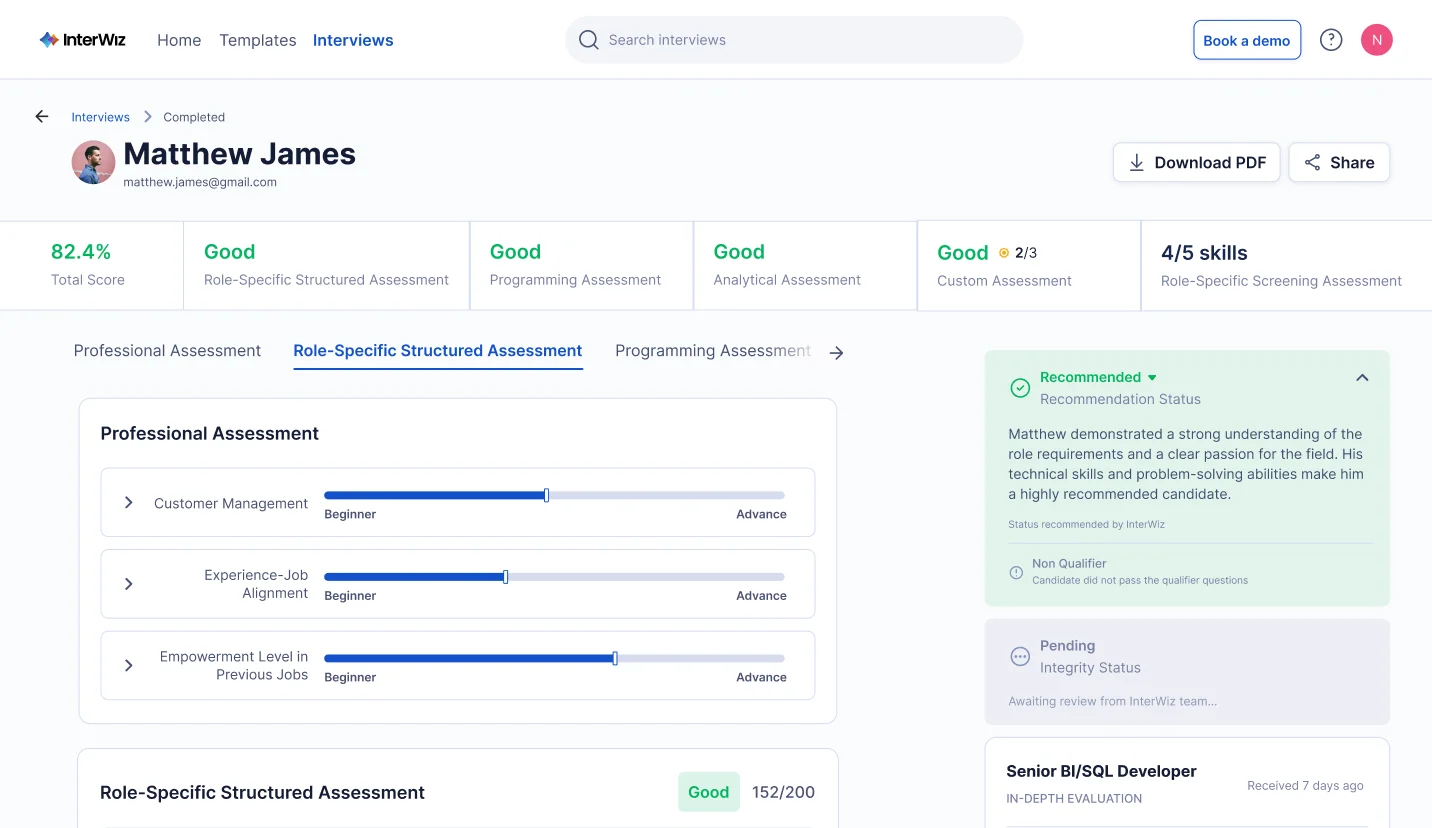
Interwiz is an AI recruiter that helps you conduct human-like interviews to assess skills, personality, and potential at scale without bias, errors, or loopholes. Here’s what skills-based hiring with Interwiz looks like:
Quick setup: Sign up to Interwiz and create a template for the open position in your organization. Enter the shortlisting criteria and job description to generate a customized screening interview and assessment.
Customized hiring: Tailor interview questions based on your preferences. For example, if you want the screening interview to focus more on past experience than work ethic, you can add or remove questions accordingly.
Live technical assessments: Assess programming skills through real-time coding assessments available for technical in-depth interviews.
Consistent scoring: Evaluate candidates using consistent and accurate scoring aligned with your shortlisting criteria. Interwiz also generates instant recommendations to help you make faster hiring decisions.
Understand personality traits: Gain insights into the candidate’s personality, such as thinking capabilities, social traits, and energy perception.
Review recordings and transcripts: Access interview recordings and transcripts so you can apply your own judgment to the process.
Start Implementing Skills-Based Hiring in Your Company Today
Skills-based hiring helps you gain monetary and productive value only if implemented correctly. Using Interwiz ensures that your hiring process is accurate, consistent, and focused on real skills and potential. It eliminates bias and guesswork, allowing you to make confident hiring decisions.
Start transforming your hiring process today and experience a faster, fairer, and more accurate approach to evaluating talent. With Interwiz, you can move beyond traditional resumes and unlock a smarter way to find the right people for your organization.
Start your free trial or book a demo to begin building a strong team.

High Quality Screening with AI Interviews
Automated interviews built for speed, scale, and accuracy.
🔥 Full features, no credit card required.