
About the Customer
Emumba is a software services company that partners with startups and enterprises to design, build, and scale software products. Its teams work closely with customers, often embedding within client-facing delivery teams to ship and support production systems.
Emumba employs 350+ engineers across multiple geographies and hires approximately 80 engineers globally each year across engineering and business functions.
Because new hires are typically deployed directly into active delivery teams, hiring quality is critical. At the same time, delivery commitments leave little room for slow or fragmented hiring processes, making speed, consistency, and decision confidence equally important.
The Challenge
We were spending more time scheduling and repeating the same first-round interviews than actually evaluating candidates. By the time we reached good applicants, they had already accepted other offers.
As Emumba’s hiring volume increased, pressure began to build in the interview stage of the hiring process.
On average, time to hire was close to seven weeks per role. While sourcing was not the primary issue, progress slowed once candidates entered interviews, affecting team ramp-up and delivery planning.
The most consistent bottleneck was interviewer availability. Senior engineers, whose input was essential for assessing technical depth, had limited time to participate in early-stage interviews while balancing delivery responsibilities. Coordinating calendars often extended hiring cycles and, in some cases, resulted in candidates dropping out mid-process.
There was also a lack of consistency in interviews and feedback. Interview approaches varied across teams and interviewers, and feedback was not always detailed or structured, making it difficult to compare candidates objectively and make confident early decisions.
In summary, Emumba faced five core challenges:
- 1Extended time to hire, driven by delays in early-stage interviews.
- 2Limited availability of senior engineers, creating scheduling bottlenecks.
- 3Inconsistent interview approaches across teams.
- 4Incomplete or unstructured interview feedback.
- 5Higher risk of misaligned or sub-optimal hires, requiring downstream correction.
Emumba needed a hiring process that could move faster, reduce dependency on senior engineer availability, and produce clear, comparable signals for every candidate.
The Solution
To resolve these issues, Emumba introduced InterWiz as a replacement for manual screening interviews and the first in-depth technical interview.
InterWiz was rolled out gradually, starting with frontend engineering roles, and then expanding across backend, DevOps, QA, HR, and business functions such as Marketing. This phased approach allowed teams to adopt the platform within their existing hiring workflows, without disrupting ongoing recruitment.
With InterWiz, Emumba automated early stages of the hiring process while keeping human decision-makers firmly in control. The platform introduced structure and consistency through:
- AI-based resume screening, where recruiters define evaluation criteria and InterWiz scores resumes automatically, significantly reducing manual effort.
- Live coding assessments, allowing candidates to work through real problems in technologies such as Javascript, Python, and other relevant stacks.
- Analytical and role-specific evaluations, providing objective measurements of the skills and competencies hiring teams care about.
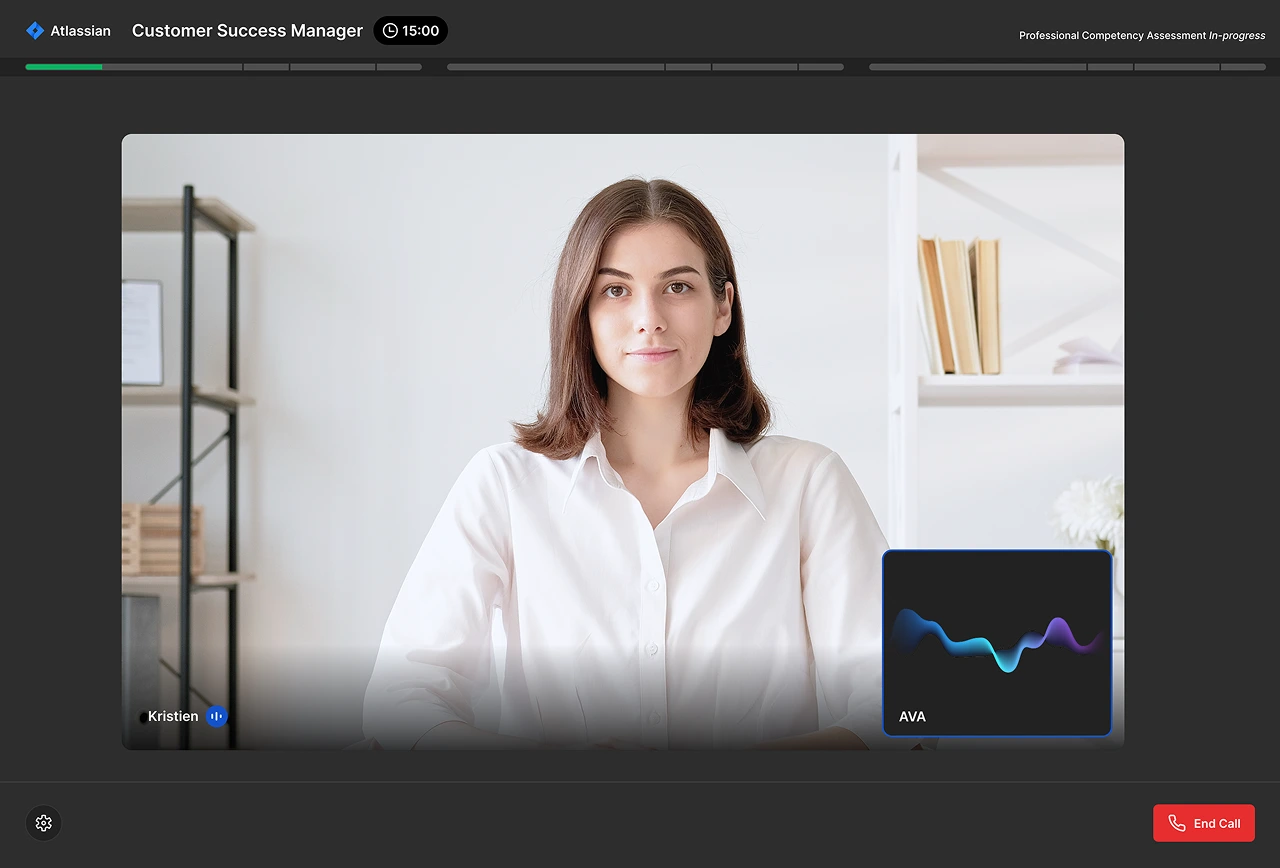
- Standardized interview reports, highlighting strengths, gaps, and clear hiring recommendations for each candidate.
- Candidates ranking and side-by-side candidate comparisons, enabling data-backed decisions over time.
- Interview recordings, allowing senior engineers to review evaluations asynchronously rather than scheduling live screening calls.
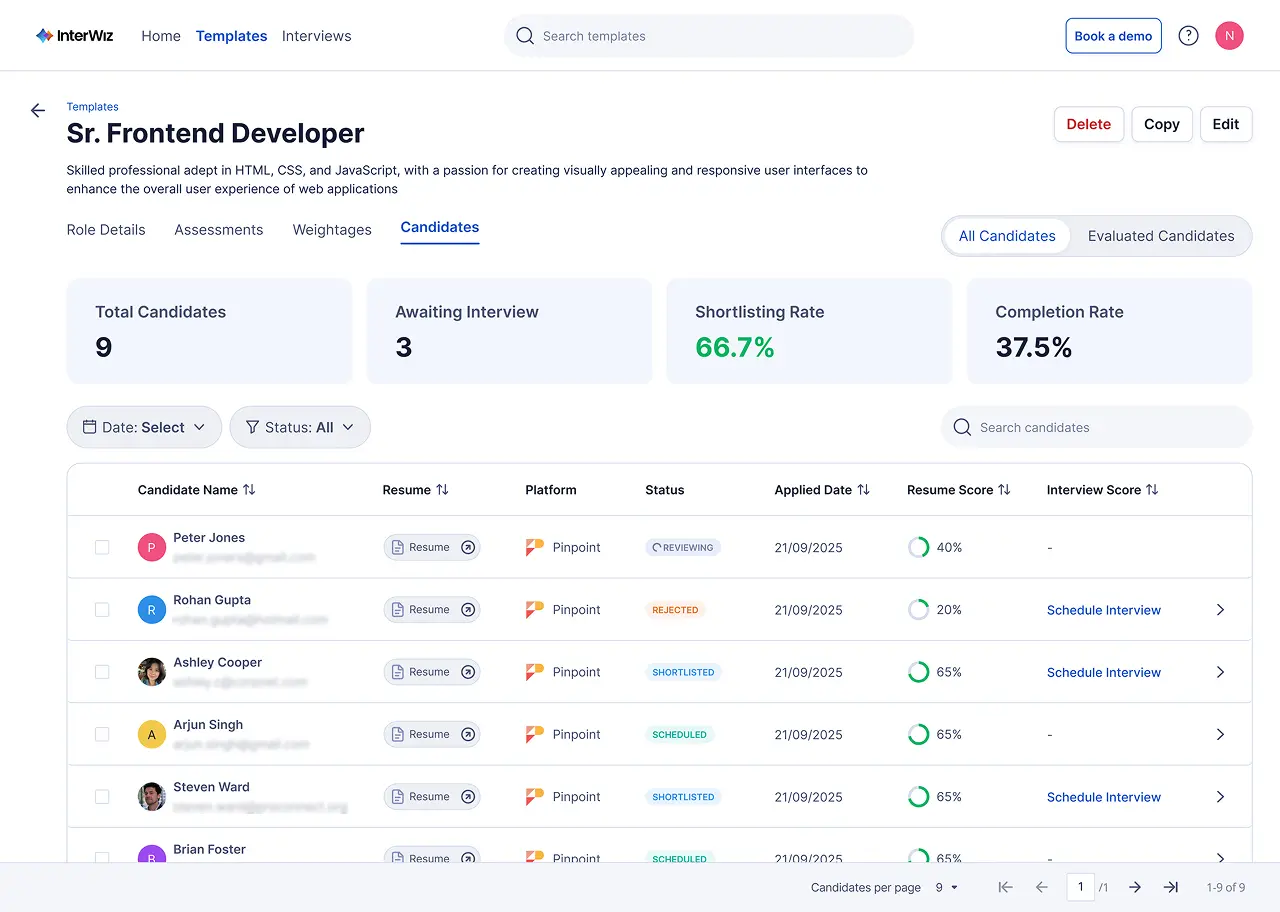
To make the experience seamless, Emumba also adopted a two-way integration with its ATS, PinPoint. Recruiters can schedule InterWiz interviews and view structured PDF reports directly within PinPoint, while hiring teams can access complete candidate profiles and evaluation history inside InterWiz, making the system a natural extension of their existing workflow.
The Result
By replacing manual screening with structured, AI-powered assessments, Emumba reduced its time to hire from approximately seven weeks to three weeks, a 60% reduction without sacrificing evaluation depth or consistency.
Additional outcomes included:
- Reduced reliance on senior engineer availability.
- Fewer mis-hires driven by objective comparisons.
- Improved tracking of historical candidate evaluations.
Standardized evaluation reports across roles and teams.
InterWiz has made our hiring process super simple and automated. We’ve cut our time to hire by 60%, and the platform helps us make fair and informed decisions. It’s been a game-changer for us.
Future Plans
Building on these results, Emumba plans to extend its use of InterWiz to initial phone-based AI screenings across all roles.
This next step will standardize the very first stage of hiring, ensuring early signals are captured consistently before candidates move further into the process. By handling initial screenings through InterWiz, the team aims to reduce manual coordination even further while preserving fairness and structure at scale.
The focus going forward is to keep hiring fast, consistent, and predictable, without increasing operational load as hiring volumes grow.
More to Explore

 Case Study • 8 min read
A recruiting firm reduced screening effort by 50%
By automating global screening interviews, the recruiting firm eliminated coordination bottlenecks, reduced recruiter workload, and evaluated candidates faster across time zones.

400+ applicants to 1 hire in under 2 recruiter hours
By automating screening and shortlisting, the team evaluated 400+ applicants in weeks instead of months, reducing recruiter effort and accelerating hiring decisions.

From 150+ applicants to 1 confident design hire
DvSum transformed its design hiring process by replacing manual shortlisting with structured, AI-powered interviews—enabling a large applicant pool to be evaluated consistently and efficiently, resulting in a confident final hire.